
Reviewed · NAMIB DESERT TOURS
Cruise liner Special: Swakopmund and Namib Desert Highlights
The striking idea here is simple: one long day connects Swakopmund, desert geology, ancient plants, an oasis, dunes, and hundreds of thousands of birds. I like the range. You get far more than a quick town visit, and a good local guide can turn a stark stretch of desert into a story about colonial rule, mining, water, fog, and survival.
I also like the cruise-port timing and the attempt to avoid arriving at each stop with large busloads. The tradeoff is real: this is a shared tour with long drives, basic vehicle seating, and up to 25 people. If you prefer slow sightseeing or dislike hours on gravel roads, this may feel rushed and costly.
Key points
- Swakopmund in one hour: Walk the Jetty and Mole, then see German colonial buildings, old hotels, and the former station area.
- Namib geology up close: The Moon Landscape viewpoints reveal old lava flows, ice-age traces, and uranium exploration sites.
- Welwitschia plants: Spend about two hours seeing one of the Namib’s strangest survivors, a plant with two leaves that can live for centuries.
- A cruise-friendly schedule: Pickup begins at Walvis Bay Port and is arranged around ship arrival and disembarkation times.
- A shared, long-distance outing: The group can reach 25 people, and the route covers a great deal of ground in roughly 7.5 hours.
- Wildlife at the finish: The Walvis Bay Lagoon may offer flamingos, pelicans, terns, cormorants, and other birds.
From Walvis Bay Port to Swakopmund’s old waterfront

Your day begins at Walvis Bay Port, a practical meeting point for cruise passengers. The operator shapes pickup times around the ship’s arrival, and the vehicle is expected to wait if the ship docks late while you make your way ashore. That is important here. A port excursion only has value if it gets you back to the harbor on time.
The drive heads north toward Swakopmund, passing Bird Island, described as the only man-made guano island. Even before the main stops, you begin seeing how closely this coast is tied to birds, fishing, shipping, and the dry Namib environment.
Swakopmund is about 40 kilometers from Walvis Bay, but this is not a quick shuttle into town and back. The tour uses the town as the opening chapter of a much larger story. You get a brief walk near the waterfront, then leave the paved streets for the gravel plains.
More namib desert tours in Walvis Bay:
- Namib Desert Landscape Tour
★ 5.0 · 20 reviews - Cruise liner special: Swakopmund and Namib Desert Highlight Tour
★ 4.5 · 5 reviews - NAMIB DESERT TOURS, Full-Day and Half-Day Tours from Swakopmund, Namibia
★ 5.0 · 11 reviews
Swakopmund’s Jetty, Mole, and German past
At the Swakopmund Jetty, you have about an hour to walk and hear about the town’s German colonial past. The Jetty reaches into the Atlantic, while the Mole forms part of the old harbor area. These are useful places to get your bearings because they show Swakopmund as a coastal resort town shaped by its position between ocean and desert.
The walk is not built around a long list of formal museum visits. Instead, the guide points out old buildings and explains how the town developed. You will also drive past historic hotels and the station area, giving you a quick look at Swakopmund beyond the waterfront.
That hour is enough for a first impression, not a full city tour. If your main goal is shopping, cafés, or a relaxed look at Swakopmund’s streets, you may want a shorter town-focused excursion instead. If you want the town placed in the setting of the desert, this brief introduction works better.
Guide Hannes has been singled out for making the day engaging and for adjusting the timing to avoid crowded stops. Guide quality matters greatly on this route. The sights are spread out, and a well-informed explanation can make the long transfers feel purposeful rather than empty.
Lichen fields: life on bare gravel
After Swakopmund, the route moves onto the Namib’s gravel plains. The first stop focuses on lichen, a small growth made through cooperation between a fungus and an alga. The guide explains how each part helps the other and how the lichen manages to survive in a place that appears almost lifeless.
This is a stop that rewards patience. You are not looking at a large animal or dramatic ruin. You are learning to notice small signs of life on hard ground, where fog and very limited rain matter more than conventional rainfall.
The stop lasts about an hour, which gives the guide time to explain the biology instead of pointing at the plants and moving on. Bring your attention down to the ground, especially if you are expecting the desert to provide only big views. The Namib’s character is often found in such small details.
Moon Landscape viewpoints and the Namib’s ancient story
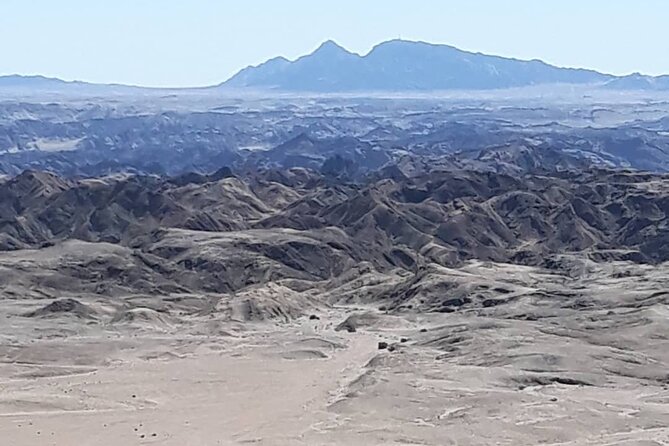
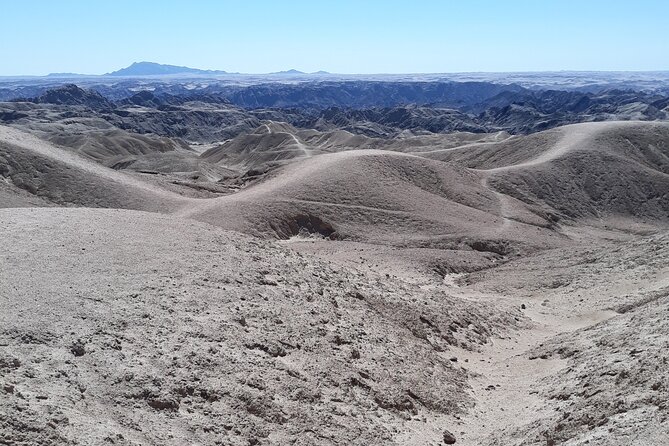
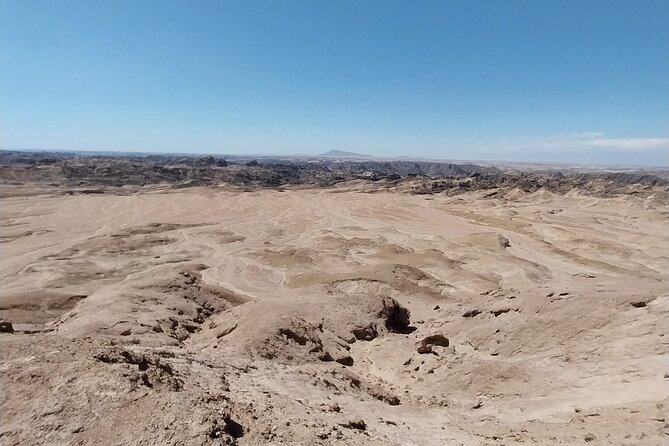
The gravel road continues to several Moon Landscape viewpoints. The name makes sense once you see the deeply weathered ground and bare hills. The area preserves signs of earlier lava flows and ice ages, giving you a physical record of conditions very different from those you experience today.
You may also see uranium exploration sites. Their presence adds a modern layer to the geological story. The Namib is not only an empty wilderness used for photographs. It has long attracted people seeking water, minerals, routes, and ways to make a living in difficult conditions.
The tour allows about an hour here. You may spot desert animals such as zebra or springbok, but sightings are not promised. Treat wildlife as a bonus, not the reason to choose this excursion.
This is one of the route’s strongest sections for anyone interested in geology. The views are broad and unusual, yet the experience depends on interpretation. Without a guide explaining lava, ice, mining, and erosion, several viewpoints could begin to look alike. With a good explanation, the ground becomes a record of time.
Same desert coast, a completely different day out:
- Walvis Bay: 4×4 Desert Excursion to Sandwich Harbour Bay
★ 4.8 · 446 reviews - Walvis Bay: Sandwich Harbour Half-Day 4×4 Scenic Excursion
★ 5.0 · 426 reviews - Pelican Point Kayaking Half-Day Tour
★ 5.0 · 349 reviews - Walvis Bay: Pelican Point Kayaking Tour
★ 4.7 · 171 reviews
Goanikontes, an oasis in a dry river
Goanikontes offers a sharp change in mood. It is an oasis in the Swakop River, an important watering place on the route from Swakopmund into the desert. The riverbed is dry, but the location’s value comes from its access to water below the surface.
The site was once linked to a police post, and vegetables were grown here. That detail helps you understand how people moved through this region before modern roads and reliable transport. A watering place could decide where a settlement, patrol, or supply point was possible.
The stop lasts about an hour and is included in the tour price. It is less polished than a conventional attraction, which is part of its appeal. You are seeing a place whose importance comes from geography and survival rather than grand architecture.
The route through the dry riverbed also makes the desert’s limits clear. A river can be absent on the surface yet remain central to human life. That contrast is one of the most useful lessons of the day.
Welwitschia Plains and a plant built for survival
The Welwitschia Plains receive roughly two hours, the longest stop on the route. That extra time is sensible because the Welwitschia plant deserves more than a quick roadside photograph.
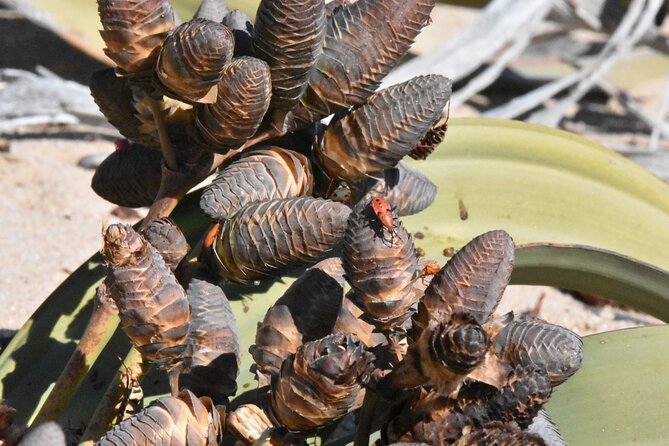
Welwitschia has no ordinary trunk and produces only two leaves. Those leaves keep growing over the plant’s life, often splitting and curling until they appear like a pile of broad, weathered ribbons. Some plants can be hundreds of years old.
The plant is adapted to collect moisture from coastal fog, along with the small amount of rain that reaches this part of the Namib. Male and female plants grow separately. Small brown and orange insects living in the plants help with pollination, while seeds spread on the prevailing winds.
You should not expect a garden or a dense field of greenery. The setting remains stark gravel, and the plants can be widely spaced. The point is the surprise of finding such old, specialized life in a place that first appears barren.
This is also where a local guide adds the most value. A photograph shows the shape of the plant. An explanation reveals its age, reproduction, dependence on fog, and relationship with insects. I would give this stop your full attention rather than treating it as a break between larger sights.
Dune 7 and the Walvis Bay Lagoon
Near Walvis Bay, the route passes Dune 7, one of the area’s best-known sand dunes. You do not climb it on this tour, and the available time allows only a view from the route. That limitation is worth noting if you specifically want a dune walk or a climb.
The final wildlife stop is at the Walvis Bay Lagoon, where you have about 15 minutes to look for flamingos. The lagoon can support more than 750,000 birds and 54 species, including Palearctic migratory birds. Pelicans, terns, and cormorants may also appear.
Fifteen minutes is short, so bring your camera out before you arrive and keep your expectations sensible. Bird numbers and visibility can change. Still, the lagoon is a fitting final stop because it connects the desert to the coast once again. Fog, shallow water, and tidal wetlands help support birds in a region where inland plant life is scarce.
After the lagoon, you return to Walvis Bay harbor. The route has covered town, coast, river, gravel plain, oasis, dune, and bird habitat in one circuit.
What the $193.68 price really covers
At $193.68 per person, this is not a cheap sightseeing transfer. The value comes from the number of separate areas included and from having a guide explain what you are seeing. You are not paying only for transport to Swakopmund. The price also covers access to the lichen field, Moon Landscape area, and Welwitschia Plains, plus the time needed to reach them.
The tour is shared, not private. The maximum group size is 25, though the actual vehicle and group may be smaller. If you want the vehicle to yourself, you must pay locally for the unused seats. Tell the operator when booking if privacy matters to you.
The route’s main cost is time and distance. You cover a wide area in about 7 hours and 30 minutes, with long stretches between attractions. One traveler found the seats uncomfortable and the driving excessive. That criticism is fair. The tour description makes the distances clear, but knowing that intellectually is different from sitting on gravel roads for much of a day.
On the other hand, another departure was adjusted to avoid crowds, and that can make a major difference. The cruise ship may offer a similar bus excursion, but a smaller shared vehicle may reach certain stops at quieter moments. This depends on the guide and the day, so do not treat it as a guarantee.
Some departures have included a desert buffet and drinks. Because food details are not fully specified as a fixed feature here, confirm what is included before you rely on lunch being provided. One person reported several days of stomach trouble after the meal, and the operator said the catering arrangement would be checked. I would carry water and any personal food you need.
Timing, guides, and practical planning
German-speaking guides are scarce. They are allocated on a first-come basis, and the operator cannot guarantee one during peak periods or when a cruise ship releases a large number of people. Request German service early if that is important to you.
At least two people are needed for the tour to operate. Most people can participate, and mobile tickets are accepted. Pickup and return are both at Walvis Bay Port, so you avoid arranging separate transport across town.
Wear practical clothes for a day that shifts between coast and desert. The supplied information does not specify a required dress code, but the route includes outdoor walks, gravel viewpoints, and open desert stops. Closed shoes and sun protection make sense. Keep your camera and water close rather than buried in luggage.
The tour offers free cancellation up to 24 hours before the start time. Changes or cancellations inside that window are not accepted for a refund. For a cruise excursion, check the local cutoff time and leave enough margin around your ship’s departure.
Who will get the most from this long desert circuit?
I would choose this tour if you have only one day in Walvis Bay and want a broad first look at the region. It is especially useful for you if Swakopmund alone feels too limited, and you want to understand why this coast has such unusual plants, birds, geology, and settlement patterns.
It suits curious sightseers who enjoy explanation as much as scenery. The strongest moments are not all photogenic at first glance. Lichen, a dry riverbed, and a Welwitschia plant become memorable when you understand how they function.
I would hesitate if you dislike long vehicle transfers, need soft seats, or want a relaxed day with plenty of free time. The itinerary has seven listed stops, but that does not mean seven leisurely visits. Several hours are consumed by the distance between them.
Families and older visitors should consider their own comfort with gravel-road travel. The information says most people can participate, but it does not give detailed mobility guidance. Ask the operator about the vehicle and walking conditions if you have specific needs.
Should you book the Swakopmund and Namib Desert Highlights tour?
Book it if you want breadth over leisure. In one port day, you see Swakopmund’s waterfront, colonial-era buildings, lichen, ancient geology, uranium sites, Goanikontes, Welwitschia plants, Dune 7, and Walvis Bay’s birds. That is a strong range for a cruise stop.
Skip it if the thought of a long drive makes you miserable. The tour’s weakness is not hidden: the sights are far apart, the seating may be uncomfortable, and the schedule leaves little room for wandering. For the right person, though, the distance is the point. You are crossing a desert to see how life survives in it.
FAQ
Where does the tour start and finish?
It starts at Walvis Bay Port and ends back at the same meeting point.
How long does the experience last?
The tour lasts approximately 7 hours and 30 minutes.
Is this a private tour?
No. It is a shared tour with a maximum of 25 people. If you want a private vehicle, you must pay locally for the extra seats.
Is the tour suitable for cruise passengers?
Yes. Pickup times are arranged around the cruise ship’s arrival and disembarkation times. The operator says the vehicle will wait if the ship docks late while you disembark.
Can I request a German-speaking guide?
You can request one, but it cannot be guaranteed. German-speaking guides are scarce and are assigned on a first-come basis.
What is the cancellation policy?
You can cancel up to 24 hours before the experience for a full refund. Cancellations or changes made less than 24 hours before the start time are not accepted for a refund.
Just added around Walvis Bay
- Walvis Bay: Seal Kayaking Adventure with Brunch★ 4.1 · 3 reviews
- Wildlife and Landscape Tour- full-day (7hours) from Walvis Bay★ 5.0 · 5 reviews
- Full Day Tour Shipwreck Sandwich Harbour Adventure★ 5.0 · 3 reviews
- Swakop River Valley & Spitzkoppe Full Day 4×4 tour from Walvis Bay★ 5.0 · 3 reviews
- Pelican Point tours,Lagoon tours, Dune7 Adventure★ 4.5 · 6 reviews
- Sandwhich Harbour Dune 4×4 Full Day★ 4.0 · 3 reviews
- Sandwich Harbour Sunset Photography Tour★ 5.0 · 6 reviews
- Mola Mola Kayaking Experience with a Licensed Guide★ 5.0 · 4 reviews
Namib Desert Tours, compared.
NAMIB DESERT TOURS, Full-Day and Half-Day Tours from Swakopmund, Namibia
Read our review →Cruise liner special: Swakopmund and Namib Desert Highlight Tour
Read our review →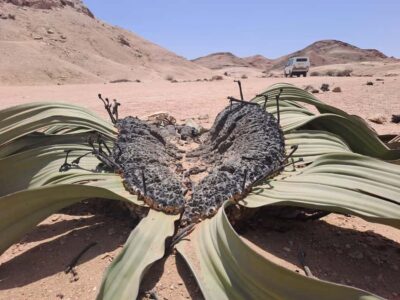
Full-Day Tour in Namib Desert from Swakopmund, Namibia
Read our review →Browse the lists this tour appears in