
Reviewed · HISTORICAL TOURS
City Tour of Historical Swakopmund
Swakmund’s old center feels unexpectedly European, with ornate German buildings set between the Namib Desert and the Atlantic. This two-hour tour follows that story through Woermannhaus, the old jetty, a former military hospital, Haus Hohenzollern, the Lutheran church, and the Marine Memorial. Guide Hans-Dieter adds local knowledge and family ties to the town’s past.
I like the tour’s compact two-hour length, which makes it easy to fit into a day of sightseeing, and I like that the buildings are not treated as empty façades. You learn what they were built for, who used them, and how the port shaped Swakmund. The main consideration is that this is a history-focused outing, so anyone wanting wildlife, desert scenery, or lots of free time inside buildings may find the scope narrow.
Key points at a glance
- Woermannhaus reveals Swakopmund’s trading power: See the 1894 headquarters of the Damara and Namaqua Trading Company, including its former lookout tower.
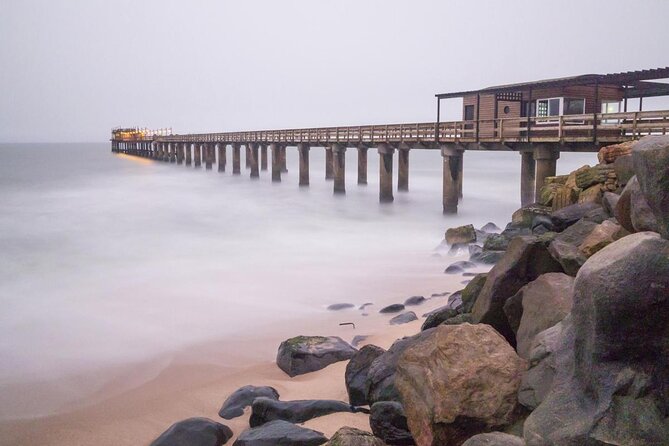
- The jetty tells a story of ambition and failure: The planned 640-meter structure reached only 262 meters before the First World War stopped construction.
- German colonial architecture remains central: Haus Hohenzollern, the Lutheran church, and Prinzessin-Rupprecht-Heim show different sides of early twentieth-century town life.
- Hans-Dieter gives the tour a local voice: His family connection to German immigrants and lifelong experience in Swakopmund add useful context.
- You return to the Swakopmund Museum: The meeting point is also a practical place to continue exploring afterward.
- The price is reasonable for a private-feeling history lesson: At $37.16 per person, the value depends on how much you enjoy architecture and local history.
Why Swakopmund’s old center deserves two hours
Swakopmund is often used as a base for desert excursions, coastal drives, and adventure activities. Yet the town itself deserves attention. Its German colonial character is unusually well preserved, and many old buildings are still in use rather than fenced off as museum pieces.
That survival gives the walking tour its appeal. You are not simply looking at old walls. You are tracing how a port town was planned, how commerce and military life shaped it, and how buildings from the colonial period remain part of daily Swakopmund.
The tour begins at the Swakopmund Museum on Strand Street and ends back at the same point. That simple arrangement works well. You do not need to arrange a separate ride back, and you can use the museum as your next stop if you want more background after the walk.
The experience lasts about two hours. That is enough time for six major sights without turning the outing into an exhausting lecture. The schedule allows roughly 30 minutes at Woermannhaus, 15 minutes at the jetty, 20 minutes at Prinzessin-Rupprecht-Heim, 15 minutes at Haus Hohenzollern, 20 minutes at the Lutheran church, and 20 minutes at the Marine Memorial.
A few more Swakopmund trips to weigh up
- Swakopmund Best Cultural Historical Township Tours Namibia
★ 5.0 · 8 reviews - Explorer Historical Private Township Cultural Tours
★ 4.0 · 6 reviews - Half Day Swakopmund Cultural Historical Township Tour
★ 5.0 · 4 reviews
Woermannhaus and the story of trade
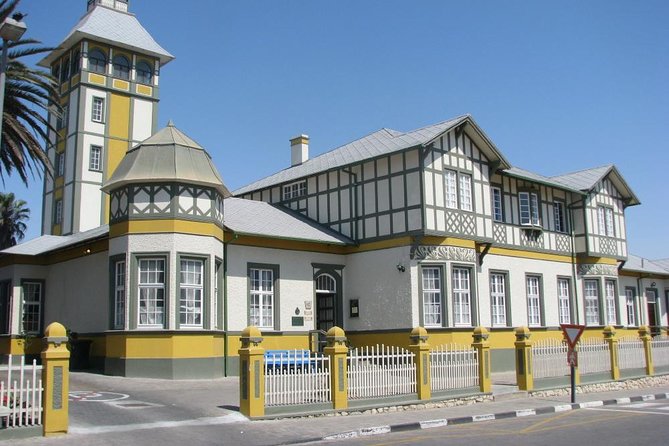
Woermannhaus on Bismarck Street is the tour’s longest stop, and for good reason. Built in 1894 by the Damara and Namaqua Trading Company, it became the headquarters of the leading trading company in what was then South West Africa.
The building was later extended in 1903 and 1904 with wood-paneled offices. Its design follows architect Friedrich Höft’s Fachwerkbau style, a timber-framed approach associated with German building traditions. Against the dry surroundings of coastal Namibia, the detailed construction feels especially distinctive.
The courtyard once held an evergreen garden. That small detail helps you picture the building as more than an office block. It was a workplace, a residence for selected officials and employees, and a center of commercial power.
Look up toward the northwest corner for the Damara Tower. It served as a lookout, flag mast, and navigation point. A tower with several practical uses tells you a great deal about early Swakopmund. Before modern communications and navigation systems, a high point could help guide ships, signal activity, and watch the harbor.
You receive no admission charge at this stop, but the real value comes from the explanation. Without context, the ornate building is attractive. With context, you begin to understand how trading companies helped shape the town.
The jetty and Swakopmund’s unfinished harbor dream
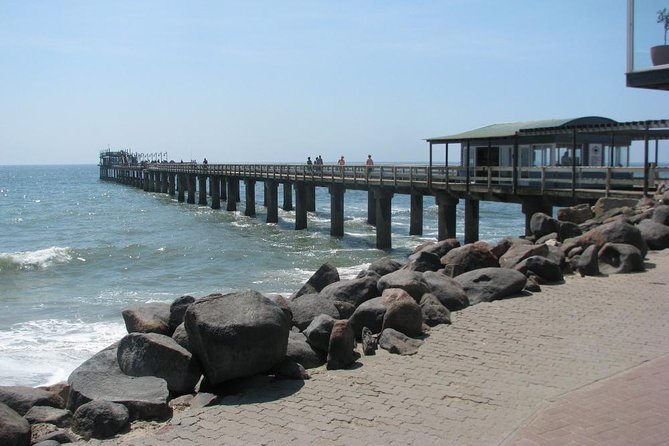
From the commercial center, the tour moves to the iron Swakopmund Jetty. The structure built in 1912 replaced an earlier wooden jetty that had deteriorated. Plans called for a 640-meter extension, but the rocky seabed caused serious construction problems.
The builders had to create a drilling program to deal with the difficult ground. Then the First World War began, and work stopped. The finished jetty reached only 262 meters.
That incomplete length is part of the story. The jetty represents the effort to give Swakopmund a workable harbor, along with the limits imposed by the Atlantic coast and world events. It also survived more than 70 years of heavy Atlantic wave action with little or no repair, a remarkable record for an iron structure exposed to such conditions.
You spend about 15 minutes here, so expect a short historical stop rather than a long walk along the structure. The jetty is most useful when your guide explains why it was built, why construction proved so difficult, and how the harbor influenced the town’s development.
If you have already seen the jetty on your own, the tour still adds value by connecting it to the other buildings. The port was not an isolated feature. It helped bring traders, officials, military personnel, and new construction to Swakopmund.
Prinzessin-Rupprecht-Heim and changing military use
Prinzessin-Rupprecht-Heim offers a different view of early Swakopmund. Built in 1902, it first served as a military hospital. The hospital closed in 1909, and the building became a convalescent home in 1911.
Its name came from Princess Rupprecht, patroness of the Bavarian Association and wife of the heir to the Bavarian throne. In 1913, the Bavarian Women’s Association of the Red Cross took over the building and arranged major renovations, supported by a donation of 35,000 marks.
The building’s changing use makes this stop more revealing than a simple architectural visit. It shows how a town’s institutions changed as its population and needs changed. A military hospital became a recovery home, and then came under the care of a women’s Red Cross association.
You spend about 20 minutes here. The stop is especially worthwhile if you want to understand social history, not just trade and government. It offers a glimpse into the medical and charitable systems that accompanied German settlement.
The stated stop is connected with Hotel Prinzessin Rupprecht, a bed-and-breakfast property. You should think of this as an exterior historical visit unless your guide tells you otherwise. The schedule does not promise entry into every building.
Same desert coast, a completely different day out:
- Walvis Bay: Marine Big 5 Luxury Catamaran Tour
★ 4.8 · 1,012 reviews - Swakopmund: Desert Dunes Quad Biking with Optional Sandboard
★ 4.9 · 590 reviews - Walvis Bay and Sandwich Harbour Tour
★ 4.8 · 483 reviews - Scenic Sandwich Harbour Tour
★ 5.0 · 277 reviews
Haus Hohenzollern’s theatrical façade
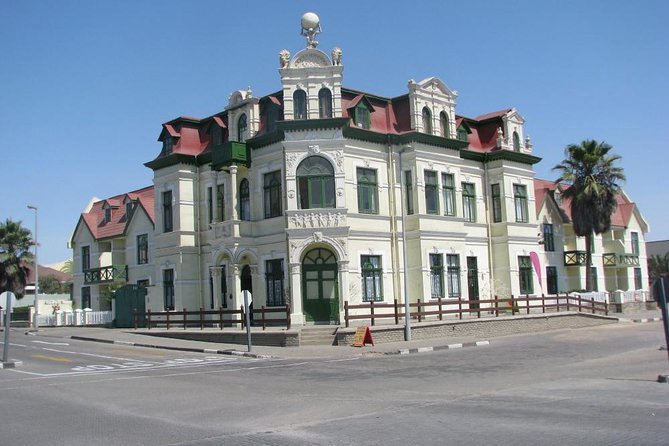
Haus Hohenzollern was built between 1904 and 1906. It was once a hotel and remains one of the most decorative buildings on the route.
The details are hard to miss. Cupid and flower ornaments cover parts of the façade. Two lions edge the corner pediment, while an imperial image of Atlas carries the world on his shoulders. The building rises above those beside it, giving the old hotel a strong presence in the street scene.
This is one of the tour’s best stops for visual appeal, but the guide’s explanation keeps it from becoming a quick photo pause. You learn how German architectural ideas were adapted in a town facing the harsh conditions of the Namib Desert.
The stop lasts about 15 minutes. That is enough time to study the façade and hear its story, though architecture fans may wish they had longer. You will likely see the building from outside rather than tour its former hotel rooms.
Haus Hohenzollern also helps break up the historical themes. Woermannhaus is tied to commerce, Prinzessin-Rupprecht-Heim to medical and charitable work, and this building to hospitality and public display. Together, they show a town trying to present itself as a proper European settlement.
The Lutheran church and a local story about faith
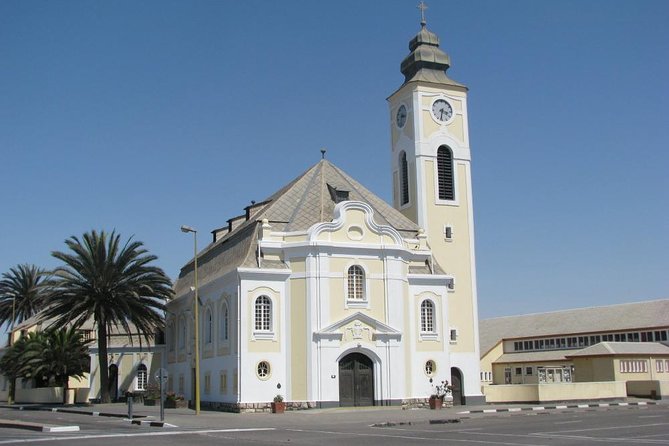
The German Evangelical Lutheran Church, along with its adjacent parsonage, brings religious life into the tour. The church was designed by Architect Ertl in an artistic Neo-Baroque style after the congregation began planning a permanent building in 1909.
A local story says that Pastor Vedder once returned home disappointed after an open-air service in 1905 drew no one. His home was described as a wooden crate without a roof, doors, or windows, and he still had his neatly folded sermon. It is a memorable tale because it turns a dry architectural subject into a picture of how rough the early settlement could be.
Construction began in 1910 under builder F. H. Schmidt, at a cost of 85,000 marks. Franz Schilling of Apolda, Germany, cast the church’s three bells.
You have about 20 minutes here. This is a good place to ask your guide how the church fits into the wider town story. The building reflects the effort to create permanent institutions, not just temporary facilities for a port and military outpost.
As with the other stops, do not assume that a scheduled visit guarantees a full interior tour. The information provided describes visiting the church and adjacent parsonage, but it does not specify opening hours or interior access.
The Marine Memorial and the difficult colonial past
The Marine Memorial is dedicated to members of Germany’s First Marine Expedition who were killed in action. Its central statue shows a marine beside a fallen comrade. Berlin sculptor A. M. Wolff designed the work, and Gladenbeck A. G. in Berlin cast it.
The crew of the gunboat Panther presented the monument to Swakopmund on July 26, 1908, on behalf of the Marine Infantry. It became a National Monument in 1969.
This is a detailed monument, but it also requires a thoughtful explanation. The memorial reflects German military memory and colonial rule. Seeing it without that context can leave you with only an impression of military pride. A good guide can help you place it within the broader history of South West Africa.
The tour information emphasizes the monument’s artistic detail and origin. The wider historical meaning may depend on the questions you ask. If you want a fuller account of colonial conflict and its effects on local communities, tell Hans-Dieter at the beginning. His background in Swakopmund and Namibia makes him a useful person to ask, though the tour’s listed focus is the historical center and its buildings.
You spend around 20 minutes here, making it one of the longer stops. That gives you time to inspect the sculpture and discuss what the monument represents.
Hans-Dieter’s local perspective
Guide Hans-Dieter is the name most closely associated with this experience. He has family ties to German immigrants, with grandparents who migrated from Germany, and he has lived in Swakopmund his whole life.
That background matters on a town history walk. You are not only receiving dates and architectural labels. You can ask how older buildings fit into modern Swakopmund and how the town’s past affects its present identity.
Hans-Dieter is also described as prompt and clear in his explanations. He has led both walking and driving tours around town, although the experience described here is a walking tour focused on the historical center. If you specifically want a wider circuit that includes townships or areas beyond the center, confirm the format when booking.
The guide’s strongest role is connecting separate sights. Without that link, the jetty, trading house, church, hospital, hotel, and memorial can feel like unrelated stops. With a good explanation, they form a timeline of commerce, settlement, religion, military life, and public memory.
What the $37.16 price gives you
At $37.16 per person, this is not the cheapest way to look at Swakopmund’s buildings, since many of the sights can be viewed from public streets. You are paying for structure, interpretation, and the chance to ask questions while moving between the landmarks.
I consider the price fair if you care about the town’s past and want more than a self-guided stroll. The 30 minutes at Woermannhaus alone gives the guide time to explain the trading company, later extensions, former residents, courtyard, and tower. The remaining stops add a useful range of subjects.
The value is less clear if you mainly want photographs or plan to spend only a short time in Swakopmund. You can see several façades independently. The tour earns its fee through the stories behind them.
The group can include up to 25 people. That is small enough for a standard group outing, but it may not feel intimate at the maximum size. Since the tour depends on spoken explanation, stand near the guide and ask for clarification if the group is full.
Pickup is offered, and the meeting point is the Swakopmund Museum. The booking includes a mobile ticket and confirmation at the time of booking. Most people can participate, and the meeting point is near public transportation.
Who should take this Swakopmund walk?
I would choose this tour early in a Swakopmund stay. It gives you a useful map of the center and helps you understand why the town looks so different from other Namibian destinations.
It suits you particularly well if you:
- Enjoy architecture, old ports, and local stories
- Want a short activity between longer desert or coastal outings
- Prefer a guide who can explain dates and building uses
- Are visiting Swakopmund for the first time
- Want to connect German colonial structures with modern town life
It may be less suitable if you want a food tour, wildlife experience, museum-heavy visit, or long exploration outside central Swakopmund. It also may not satisfy you if you expect to enter every building. Several stops are described as visits or views, but interior access is not guaranteed.
The tour requires a minimum number of participants. If that minimum is not reached, the provider offers another date or experience, or a full refund. You can cancel for a full refund up to 24 hours before the start time. Changes or cancellations inside that window are not accepted.
My recommendation for booking
Book the City Tour of Historical Swakopmund if you want the town to make sense, not just look attractive. The best parts are the clear route, the range of buildings, and Hans-Dieter’s local connection to Swakopmund’s German past.
For the strongest experience, take it near the start of your visit and treat the two hours as an introduction. Afterward, you can return to any building that caught your attention, continue at the Swakopmund Museum, or explore the center with a better sense of what you are seeing.
At $37.16, it is a fair buy for history-minded visitors. Skip it if your schedule is already packed with activities and you are happy to view the old buildings without explanation.
FAQ
Where does the tour begin?
The tour begins at the Swakopmund Museum, at 8GFF+Q62, Strand Street, Swakopmund, Namibia.
Where does the tour end?
The activity ends back at the Swakopmund Museum meeting point.
How long does the tour last?
The tour lasts approximately two hours.
How much does the tour cost?
The listed price is $37.16 per person.
Is pickup available?
Yes, pickup is offered.
Is a mobile ticket provided?
Yes, the experience includes a mobile ticket.
How many people can join the tour?
The maximum group size is 25 people.
Which buildings are included?
The route includes Woermannhaus, Swakopmund Jetty, Prinzessin-Rupprecht-Heim, Haus Hohenzollern, the German Evangelical Lutheran Church, and the Marine Memorial.
Can most people participate?
Yes, the activity information states that most people can participate.
What is the cancellation policy?
You can cancel up to 24 hours before the start time for a full refund. Cancellations or changes made less than 24 hours before the start time are not accepted.
Just added around Swakopmund
- Walvis Bay Shore Excursion: Flamingos, Dune 7, Swakopmund★ 5.0 · 3 reviews
- Unforgettable Half Day Adventure, Explore Sandwich Harbour★ 5.0 · 3 reviews
- Swakopmund Explorer Township Tour in Mondesa with Nande the Township Local Guide★ 5.0 · 4 reviews
- Walvisbay Dune 7 and Swakopmund Town Half Day Guided Tour★ 4.0 · 4 reviews
- Half Day Swakopmund Cultural Historical Township Tour★ 5.0 · 4 reviews
- Spitzkoppe – Day Tour to the Spitzkoppe Mountain from Swakopmund★ 5.0 · 3 reviews
- Full-Day Tour in Namib Desert from Swakopmund, Namibia★ 5.0 · 3 reviews
- 3-Day Scenic Sossusvlei Adventure in Namibia from Swakopmund★ 5.0 · 5 reviews
Historical Tours, compared.

Half-Day Windhoek City and Township Cultural Tour
Read our review →

Swakopmund Best Cultural Historical Township Tours Namibia
Read our review →

Half Day Swakopmund Cultural Historical Township Tour
Read our review →Browse the lists this tour appears in